
Volume Adjusting Costing (VAC)
Fast - Simple - Effective
The Power of Simplicity
Volume Adjusted Costing (VAC) is a simple alternative to Activity Based Costing (ABC). It is, essentially, an add-on to an existing, well maintained, standard costing system. It works when volume is the dominant cost driver and products have similar needs for overhead support.
The advantages are speed, simplicity, understandability and credibility. VAC is an important tool for mixed-volume manufacturers. It avoids distorted product costs, the Death Spiral of Overhead and the complexity of ABC.
How It Works
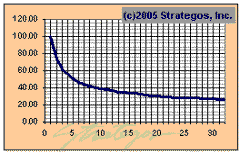
Standard cost systems calculate overhead cost for each part and for each process or work center on an annual basis. VAC further adjusts these calculated overheads High volume parts get less than the original overhead. Low volume parts get additional overhead. Total overhead remains the same, only the relative allocation changes.
All very well, but how do you know how much to adjust? Learning Curve and Experience Curve theory provides the answer.
Research during World War II demonstrated that costs went down by a fixed percentage every time cumulative production in a factory doubled. In the 1960's, the Boston Consulting Group found this effect also applies to entire industries and called it the "Experience Curve."
Learning curve formulae are simple and small programming changes calculate adjustments for thousands of parts. Common sense and judgment further modify the calculations.
VAC At Deere & Co.
In their 1999 paper for the Journal of Cost Management, Glen Navis and Bala V. Balachandran describe VAC procedure and the benefits at John Deere's Horicon Works. They also describe some frustrations with a subsequent implementation of Activity Based Costing. They have made this paper available as a download.
The Effects at Deere
Purchasing-
Deere had always intended to be a high volume manufacturer. But the costing system saddled Horicon with many low volume parts. VAC allowed outsourcing for many low volume items and helped fulfill the original strategic intent.
Engineering
John Deere had been a pioneer in Group Technology, particularly Coding and Classification. But, the design engineers did not use the coding system to avoid duplicate (or near duplicate) parts. Standard costing provided little incentive to do so. VAC gave the incentive and Deere's pioneering system was used more effectively.
Management
With VAC it was evident that an entire product line was a money loser. This line was moved to a more suitable, more focused facility. This, in turn, provided more focus at Horicon.
The Horicon Works has enjoyed great success and John Deere has risen to a dominant position in the lawn and garden market. Glen Navis believes that VAC was a key element in this success.
Download The Original Paper
Download This Paper "Volume Adjusted Costing" by Glen Navis and Bala V. Balachandran. You may contact Glen directly at gnavis1@att.net.

■ ■ ■ ■ ■ ■ ■

|
The Strategos Guide To Value Stream and Process Mapping goes beyond symbols and arrows. In over 163 pages it tells the reader how to do it and what to do with it. |

The free newsletter of Lean strategy