
The Death Spiral of Overhead
How Overhead Allocation Distortions Affect Profitability
Overhead Cost Allocation


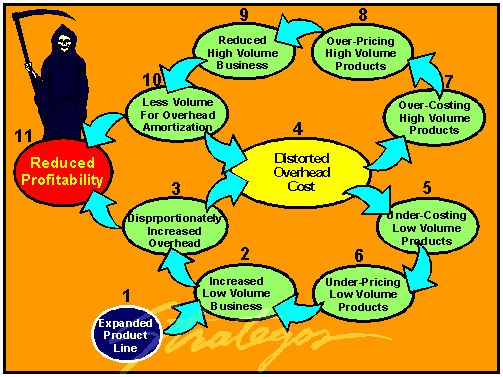
Overhead cost distortions, discussed in accompanying articles, sometimes combine with product proliferation in a slow, deadly spiral that takes decades to play out.
This usually happens to firms that start with a limited product line of relatively high volume products. The illustration and explanation below shows how this self-reinforcing process operates.
The most insidious aspect is time. With an initially successful firm, it may take decades before anyone recognizes that a problem exists. Each year, margins are a bit lower, but not enough to sound an alarm.
In addition, the normal ups and downs of the business cycle disguise the general trend. Some companies even grow as overall volume disguises thinning margins.
The problem is not with low volume products, per se. Many companies specialize in low volume and perform quite well. The real problem is mixing low and high volume combined with an over-simplified overhead allocation system.
While volume is "the usual suspect," other factors can also distort cost and drive a company into a similar death spiral. Activity Based Costing (ABC) is intended to prevent this. Focused Factories can also prevent such death spirals by ensuring that all products have similar cost characteristics.
Low Volume Loop
1) External competitive pressure or internal pressure for growth causes management to expand the product line.
2) The new products often have lower volumes than the main product line.
3) New products increase the overhead disproportionately.
4) The accounting system does not allocate overhead well between the high and low volume products.
5) Since the lower volume products do not have their real overhead costs assigned, marketing tends to under-price them.
6) The under-pricing leads to even more low volume business and the loop reinforces.
High Volume Loop
A symmetrical self-reinforcing loop affects high volume products with the opposite effect on pricing and the same effect on profits..
7) Cost distortions over-cost high volume products.
8) Marketing over prices the high volume products.
9) Less (proportionately) high volume business results from the over-pricing.
10) The reduced high volume business must now absorb even more overhead and further distorts cost.
11) Real margins decline.

■ ■ ■ ■ ■ ■ ■

|
The Strategos Guide To Value Stream and Process Mapping goes beyond symbols and arrows. In over 163 pages it tells the reader how to do it and what to do with it. |

The free newsletter of Lean strategy