
One Piece Flow
Magic, Myth or Something Else?
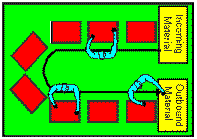
One Piece Flow refers to the concept of moving one workpiece at a time between operations within a workcell. At the opposite extreme, we might process an entire batch or lot at each operation before moving it to the next operation. This idea has many benefits. It keeps WIP at the lowest possible level. It encourages work balance, better quality and a host of internal improvements.
We often hear One Piece Flow pronounced as an absolute must for any workcell. Like the search for the Holy Grail it is taken as a moral imperative. At Strategos, we find it more helpful to think of this question as the "Transfer Batch" or "Internal Lot size." The issue is: "What Internal Lot Size will help the cell meet its performance goals."
To approach engineering design using slogans, edicts, or other grand pronouncements is a dangerous business. Here are some of the more common edicts:
- Inventory is evil and must be eliminated regardless of all other considerations.
- The only relevant measure of work-cell performance is throughput time.
- Machine utilization is of no consequence and should be ignored.
- Work-cells must have a straight-through flow for all products.
- Work-cells must have one-piece flow.
- Low-tech, manual machine tools are superior to high-tech NC equipment.
Performance goals may vary from one cell or factory to the next. For some, Quality is the foremost measure of performance. For others, delivery speed and customer response dominates. For others, labor efficiency is foremost. Where equipment is expensive and capital scarce, equipment utilization may play a role, although it is often overrated..
 The
question of Internal Lot Size is just one of many decisions that specify the workcell design.
Every engineering design is a series of decisions, made in a logical sequence and often
interdependent. For more on this, see our page on Rationalized Workcell Design.
The
question of Internal Lot Size is just one of many decisions that specify the workcell design.
Every engineering design is a series of decisions, made in a logical sequence and often
interdependent. For more on this, see our page on Rationalized Workcell Design.
One Piece Flow is an ideal that engineers should strive for. But, it simply does not work when the transfer time begins to approach the work time. Nor does it work with certain processes such as shot blasting. When a cell must address a wide product variety with varied routes, work times, and setup times, One Piece Flow is also counterproductive. This often occurs in jobbing-type machine shops or sheet metal shops.
In situations such as those mentioned above, small-batch flow can be a good answer. For example, the lot size required by a customer might be 100 units of product. This is the "External Lot Size." The optimum "Internal Lot Size" or "Transfer Batch" might be 10 units.
In operation, the first operation in the cell makes 10 units of the 100 and passes the 10 units to the second operation. The first operation then makes 10 more units and passes them along. This continues until the External Lot of 100 is complete.
The best workcells are engineered designs which address both the technical and human issues. Learn more...
- Workcells- The Heart of Lean Manufacturing
- How To Design Workcells
- Workcell Design for Lean Manufacturing - Seminar
For Examples of Inappropriate Use of One Piece Flow, Click Below
Where One Piece Flow Did Not Work
An investment foundry manufactures small parts for aircraft and stationary turbine engines. The technology is difficult, and unpredictable. Much of the equipment is large scale. There are about 4000 active part numbers with wide variations in routings and work content.
Several years before, some of their engineers had attended a large-scale Kaizen Blitz. These engineers had accepted the usual dictums about "One Piece Flow" and "Sequential Arrangements". But, the complex product and process mix had baffled all attempts to put these dictums into practice. As a result, nothing had been done towards implementing workcells.
A Strategos consultant implemented the first workcell within a few days. It functioned well with impressive results.
Subsequently, the firm's engineers attempted to implement a workcell in different area with very poor results. What had gone wrong with this second cell?
The primary issue was "One Piece Flow". The engineers had accepted this dictum quite literally. But the product and process did not lend itself to One Piece flow. Operation times were very short, about 15-20 seconds. The parts were very small (about 1-1/2"). One process step, shot-blast, required a large number of parts in order to function properly. Compounding this was the excessive distance between machines.
Operators spent more time walking parts than they did processing the parts. The shot blast machine was eating itself alive because the blast impinged on the machine parts rather than workpieces.
When inquiries were made about why only a single piece was moved, the answer was, essentially, "Because that fellow from Nagoya told us we had to do it that way."
One Piece Flow is an ideal that engineers should strive for. But, it simply does not work when the transfer time begins to approach the work time. Nor does it work with certain processes such as shot blasting.
The people involved had great difficulty in reconciling their deeply held faith in "One Piece Flow" with the realities of the situation. The problem was resolved semantically.
The word "piece" was simply redefined as 20 castings . Small carriers were built to carry the 20 castings or in Newspeak, the single piece. In addition, queues were setup to allow accumulation of a reasonable quantity for shot blasting. In this way, each transfer time was amortized over 20 parts instead of just one and the shot wheel had something worthwhile to blast on. The cell began to function effectively.
This project was the genesis of Mr. Lee's subsequent works that bring order, structure, and rationality to the cell design process.
■ ■ ■ ■ ■ ■ ■
|
The Strategos Guide To Value Stream and Process Mapping goes beyond symbols and arrows. In over 163 pages it tells the reader how to do it and what to do with it. |

The free newsletter of Lean strategy