
Jidoka & Autonomation
A Pillar of Toyota Production System
The Confusion Over Jidoka
Jidoka, as practiced at Toyota has several meanings. It may mean "automation with human intelligence" (Autonomation). Jidoka also refers to the practice of stopping a manual line or process when something goes amiss.
Autonomation (Jidoka)
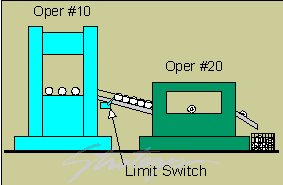
In one form, Jidoka uses limit switches or devices that shut down a process when:
- The required pieces have been made.
- A part is defective
- The mechanism jams.
The purpose is to free equipment from the necessity of constant human attention, separate people from machines and allow workers to staff multiple operations. This form of Jidoka relates closely to Shigeo Shingo's concept of Pokayoke.
Line Stop Jidoka
Jidoka, as applied to manned operations, refers to the practice of stopping the entire line or process when something goes amiss. This has important psychological and practical effects that contribute greatly to "continuous Improvement."
 Taiichi Ohno considered Jidoka one of the two pillars of the Toyota Production System (TPS).
Yet this aspect of TPS is mostly ignored in the West. When it is discussed, there is a lot of
confusion and misunderstanding. There are several reasons, among them:
Taiichi Ohno considered Jidoka one of the two pillars of the Toyota Production System (TPS).
Yet this aspect of TPS is mostly ignored in the West. When it is discussed, there is a lot of
confusion and misunderstanding. There are several reasons, among them:
- Japanese language (at least in everyday usage) seems less precise than English and the several meanings of Jidoka do not translate well.
- For historical reasons, the autonomation concept seems less relevant today and more like ordinary good sense and practice.
- The line-stoppage version of Jidoka requires a strong stomach and purity of mind that few managers (Japanese or American) possess.
-
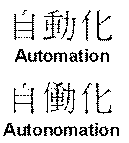
The original meaning of Jidoka was "Automation" just as in English. It was written in Kanji as shown.
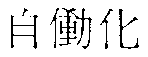
The Kamigo Engine Plant developed many stoppage devices to halt automated machines. This became the word "Autonomation". It was pronounced as Jidoka but the Kanji had a subtle difference-- the addition of a few strokes representing humans or people.
Later, the idea of stopping everything when something went wrong was transferred to manual assembly and the "Jidoka" term transferred as well.
Jidoka (Line Stoppage Variation)
 Jidoka (literally translated) means "Automation". Through shop usage at Toyota the word
has taken on other connotations. One meaning refers to the stopping of a manual assembly or
production line when something goes amiss.
Jidoka (literally translated) means "Automation". Through shop usage at Toyota the word
has taken on other connotations. One meaning refers to the stopping of a manual assembly or
production line when something goes amiss.
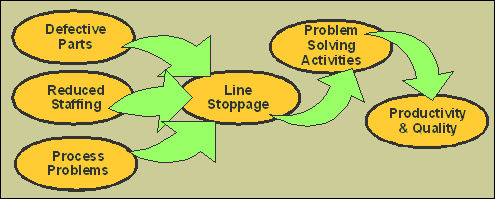
At Toyota, every worker has the authority and the responsibility to stop an entire line when a problem arises. The purpose is to bring attention to the problem, regardless of how small, and focus efforts on it. This forces a permanent solution.
It has been an article of faith in automotive plants that an assembly line must never stop. When Taiichi Ohno first told supervisors to stop the lines when trouble developed, they were incredulous.
Ohno tells of two supervisors: one who followed orders and stopped the line immediately when trouble developed and another who was reluctant to stop the line.
At first, the line that stopped frequently had lower output. After several months, however, the situation reversed. The line that rarely stopped still had the same problems. These problems stalled productivity improvements and created rework that lowered efficiency. The line that initially saw frequent stoppages found that the stoppages had been reduced and overall efficiency improved.

A Cautionary Note
Jidoka only works when the supervisors and operators have the skills and experience to fix the problems. Jidoka, itself, only spotlights the waste.
Employees should have at least twelve hours of training in Root Cause Analysis, four hours in Process Mapping and six months of intensive practice before Jidoka is employed.
Autonomation
 Autonomation
transfers a level of human intelligence to automated machinery. Machines thus detect even a
single defective part and immediately stop while asking for help.
Autonomation
transfers a level of human intelligence to automated machinery. Machines thus detect even a
single defective part and immediately stop while asking for help.
The concept was pioneered by Sakichi Toyoda at the turn of the twentieth century. He invented automatic looms that stopped instantly when any thread broke. This permitted one operator to oversee many machines without risk of producing large amounts of defective cloth.
Taiichi Ohno considered Jidoka (Autonomation is one variant) as one of the two pillars of the Toyota Production System.
So, What's The Big Deal?
This sort of interlock is commonplace today and we take it for granted. Modern equipment has many types of sensors to detect broken tools, jams, defects and other abnormal conditions.
However, in the 1950's, 1960's and 1970's, automation relied on relay logic and often required a human operator to detect abnormalities. This limited the benefits of automation
Even in the 1950's interlocks, such as the simple limit switch illustrated above, were available. What differed at Toyota was the extent of their use. Like many of Taiichi Ohno's methods, this is a simple idea that he pursued for decades until it became a strategic competitive advantage.
Where To Emphasize Autonomation
Autonomation is an important component of Lean Manufacturing Strategy for high-production, low- variety operations, particularly where product life cycles are measured in years or decades.
In high-variety, low-volume situations, the time and effort required is prohibitive. This is another example of how lean principles must be tailored to each situation.
Autonomation
A limit switch stops Operation #10 when the transfer conveyor has five pieces.
References
MONDEN, YASUHIRO, Toyota Production System, Third Edition, Industrial Engineering & Management Press, Atlanta, Georgia, USA, 1998.
OHNO, TAIICHI, Toyota Production System- Beyond Large Scale Production, Productivity Press, 1988.
■ ■ ■ ■ ■ ■ ■

|
The Strategos Guide To Value Stream and Process Mapping goes beyond symbols and arrows. In over 163 pages it tells the reader how to do it and what to do with it. |

The free newsletter of Lean strategy