
The Focused Factory
Characteristics of The Focused Factory


A Focused Factory strives for a narrower range of products, customers or processes. The result is a factory that is smaller, and has fewer Key Manufacturing Tasks. It optimizes performance on a few dimensions while sub-optimizing on others.
Aircraft design offers an analogy. Aerospace engineers can design an aircraft that flies at Mach 3.0. They can design an aircraft that carries 350 people. They can design an aircraft that circles the globe on a few hundred gallons of fuel. They can design an aircraft that lands on a 500 foot runway. They cannot design an aircraft that does all of the above because the available technology has limits. So it is with factories.
Wickham Skinner, in his seminal 1974 article for The Harvard Business Review, says it best:
"The focused factory will out-produce, undersell, and quickly gain competitive edge over the complex factory, The focused factory does a better job because repetition and concentration in one area allows its work force and managers to become effective and experienced in the task required for success. The focused factory is manageable and controllable. Its problems are demanding, but limited in scope."
The Focused Factory rests on three underlying concepts:
- There are many ways to compete besides low cost.
- A factory cannot perform well on every measure.
- Simplicity & repetition bring competence.
Benefits of Focus
At Strategos, we have seen the effects of focus- customer satisfaction, lower cost and less frustration. Several researchers have documented these effects with quantitative studies.
Key Manufacturing Tasks
Skinner's research suggests that a particular factory can excel with no more than one or two overall objectives. These might be quality, delivery reliability, response time, low cost, customization, short life cycle products, or another competitive dimension.
The Key Manufacturing Task(s) is the most important thing the factory must do or achieve for success. Terry Hill, in his book "Manufacturing Strategy" shows how to identify the Key Manufacturing Task(s) and link it to marketing and corporate strategies.
Why Factories Lose Focus
Some factories are unfocused originally because designers fail to recognize the limits and constraints of technologies and systems.
Other factories are highly focused at first but lose it over time. Several forces and factors diffuse the original focus. Among these are:
- Inconsistent Policies
- Professional Isolation
- Mission Creep
- Failure To Design The Task
- Unrecognized Inconsistencies
- Product Proliferation
- Market Proliferation
A Broader View of Focus
In recent years, we have extended Skinner's concept. The strategic question is: "by what criteria shall we divide our space, people and machines into manageable work units?" (See article: "Manufacturing Focus--A Comprehensive View")

Wickham Skinner
Wickham Skinner is considered the father of Manufacturing Strategy. His book "Manufacturing In The Corporate Strategy", published in 1978, set out the principles on which most other work has been based. His seminal article "The Focused Factory" was published in The Harvard Business Review in 1974 and is still available from Amazon.com. Dr. Skinner, a graduate of Yale, is an emeritus professor at Harvard University, where he taught and researched in the field of industrial management. Dr. Skinner has published three books, co-authored ten case books, and has written extensively for business magazines and journals.
(The following is from Professor Skinner's Article)
Process Technologies
Typically, unproven and uncertain technologies are limited to one per factory. Proven, mature technologies are limited to what their managers can easily handle, typically two or three. (e.g.,a foundry, metal working and metal finishing.)
Market Demands
These consist of a set of demands including quality, price, lead times, and reliability specifications. A given plant can usually only do a superb job on one or two demands at any given period of time.
Product Volumes
Generally these are of comparable levels, such that tooling, order quantities, materials handling techniques, and job contents can be approached with a consistent philosophy. But what about the inevitable short runs, customer specials, and one-of-a-kind orders that every factory must handle? The answer usually is to segregate them.
Quality Levels
These employ a common attitude and set of approaches so as to neither over-specify or over control quality and specifications. One frame of mind and set of mental assumptions suffice for equipment, tooling, inspection, training , supervision, job content, and materials handling.
Manufacturing Tasks
These are limited to only one (or two at the most) at any given time. The task at which the plant must excel in order to be competitive focuses on one set of internally consistent, doable, non-compromised criteria for success.
Here we present the results of five quantitative studies of how focused factory concepts affect operating performance. One might conceivably argue with the conclusions. For example:
The studies show correlation, not causality. Are there other explanations?
Why is there so much scatter in the data?
Does this really hold for other industries?
These points are valid, to a degree. Manufacturing Strategy, like any strategy is complex, ephemeral, vague and subject to the whims and chance of nature. It does not lend itself to the kind of rigorous analysis used, for example, in calculating stress in a wing spar. Nevertheless, this is some of the best quantitative evidence we have.
The Focused Factory is not a "Magic Bullet". It is, rather, one piece of a Lean Manufacturing Strategy, appropriate for many firms, when combined with other complementary elements of Lean.
Nor can Focused Factories or Manufacturing Strategy compensate for unsound corporate or marketing strategies. For example, some years ago we worked with a computer firm that dominated an important market niche. They developed and executed a highly successful Lean Manufacturing Strategy. Unfortunately, their new products did not materialize, technologies changed and the company has disappeared.
Increasing Focus Reduces Overhead
Circuit Breaker Manufacturing
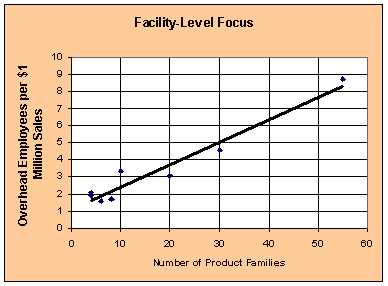
The resources necessary to cope with the complexity of many products, processes or customers generally involve overhead rather than direct labor and materials.This chart shows the number of overhead employees at each of eight plants owned by a circuit breaker manufacturer. The number of product families ranged from 4-55.
The correlation is clear: the more product families in a plant, the greater the overhead cost for a given sales volume.
This particular firm had adopted a marketing strategy of offering a complete line of circuit breakers from smallest to largest. They competed against many smaller firms that offered much more focused product lines, generally, an untenable position.
Adapted: Stalk, George & Hout, Thomas M., Competing Against Time, The Free Press, New York, 1990.
Increasing Focus Increases Operating Margin
Focusing Factories In Multi-Division Companies
The company illustrated here had seven regional factories. They had organized into divisions and each division served a different end-customer group. The plant's product lines, however, did not correspond to the marketing divisions. Each plant served more than one division. The divisions were, effectively, the plant's customers.
The charts show operating margin as a function of focus. On this first chart focus is gauged by the number of divisions served.
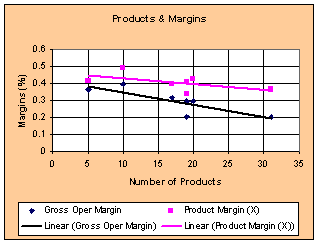
This second chart guages focus by the number of product lines at each plant.
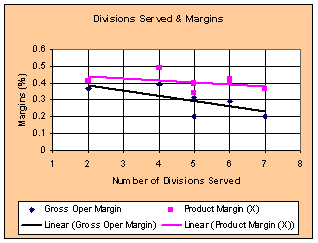
By either measure, increased focus correlates to increased profitability. One major product was common to all plants, "Product X". The margins for Product X do not decline as steeply with decreasing focus as the overall margins, but they still follow the same pattern.
The conclusion: adding low-volume products to a high volume factory will lower the high-volume product margins.
Adapted: Stalk, George & Hout, Thomas M., Competing Against Time, The Free Press, New York, 1990.
Increased Focus Improves Quality
Focus In A Steel Foundry
A steel foundry in this study manufactured wheels for trains. Prior to 1971 the foundry had two main products which accounted for 99% of their production.
When expansion left the firm with excess capacity, they engineered and sold additional products to fill the excess capacity. This went on until 1984 when quality and profitability had declined so much that the firm was in danger. The company's accounting system had not reflected the true cost of the new products and they were under-priced. The company actually lost money on most of this new production.The chart shows casting yield, an indicator of quality, during this period.
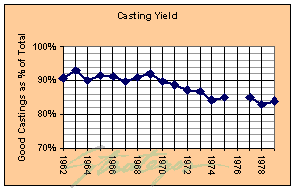
They decided to re-focus their foundry. The approach was to drastically increase prices on the new products and reduce prices on the original standard products. This insured a profit on the new products and increased volume on the original products. As a result the proportion of production devoted to the original products grew.
The purple line represents the portion of total production represented by the original two products. Between 1964 and 1971 this was essentially constant at 98%. As products proliferated, the proportion represented by the original two lines declined.

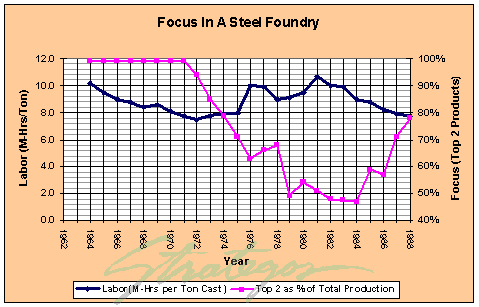
The black line represents labor productivity in man-hours per ton of good casting. From 1964 until 1972, shortly after the new products started coming on-stream, man-hr./ton declined as productivity increased. With increased variety, man-hours/ton increased starting in 1973 until 1981. This trend did not reverse until 1981.
Adapted: Stalk, George & Hout, Thomas M., Competing Against Time, The Free Press, New York, 1990.
Increased Size & Product Line Lowers Margins
Profitability In Basic Metals
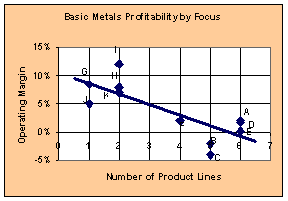
In the study results below, eight companies that produce a certain basic metal were studied by the Boston Consulting Group. Their operating margin was compared to their size (as measured in sales) and focus (as measured by the number of product lines).
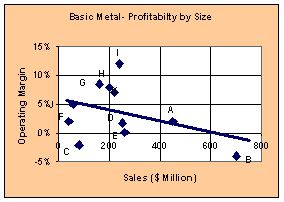
This chart indicates that the number of product lines has a more direct influence. The slope of the linear regression line is slightly steeper than the line for size and there is less scatter in the data.
Adapted: Hayes, Robert H., & Wheelwright, Steven C., Restoring Our Competitive Edge, Wiley, 1984
The Effects of Focus on Lines & Workcells
How Focus Principles Apply Within Factories
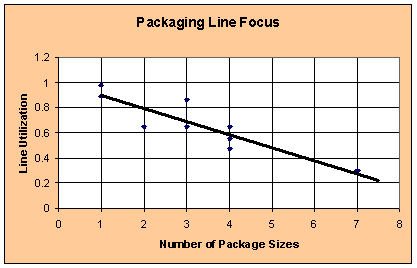
At lower levels of focus such as workcells or lines, increased focus generally brings greater utilization. The chart above shows this. It comes from a study of similar packaging lines in various German companies. As the number of package sizes increase from 1 to 7, utilization drops from 90% to 30%.
This effect is counter-intuitive. One might imagine that if all lines could produce all products, the variability in customer demand for each product would be better accommodated and overall utilization increased. However, the intangible problems of changeovers, learning curves and broader process knowledge required by all workers counteracts the effects of spreading the variability.
Adapted: Hayes, Robert H., & Wheelwright, Steven C., Restoring Our Competitive Edge, Wiley, 1984
This study supplements the experience and literature of Cellular Manufacturing. Focus at this
level simplifies the process and allows workers and mangers to apply their skills to a narrower set of problems.

■ ■ ■ ■ ■ ■ ■

|
The Strategos Guide To Value Stream and Process Mapping goes beyond symbols and arrows. In over 163 pages it tells the reader how to do it and what to do with it. |

The free newsletter of Lean strategy