
Ergonomics & Lean
The Basics of Ergonomics
Ergonomics studies work as it relates to thehuman body and its limits.The usual goal is maximum output without physical harm. The most prevalent ergonomic related injuries are musculoskeletal;either from repetition, overload, awkward positions or somecombination.
Ergonomics & Lean Manufacturing
Ergonomics is most important at the level of workcell design and workstation design. By their very nature, well-designedcells relieve many of the risk factors associated with traditionalworkstations and functional layouts. For example, workcells often rotate workers through an entire process on each cycle.This reduces repetition and static postures. Workstationsalso have a direct influence on musculoskeletal disorders.
Those who are designing a workplace may not need in-depth ergonomic knowledge, they may only require somegeneral principles and guidelines. Our page on Principles ofErgonomics provides such guidelines comparable toBarnes' Principles ofMotion Economy.
Branches of Ergonomics
Allocation of Functions
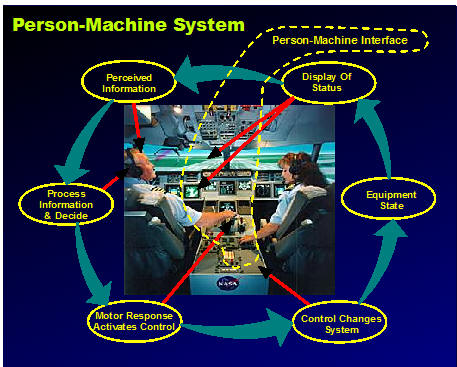
Allocation divides work between people and machines.It determines, to a large extent, the quality of work experience.A well-thought-out allocation optimizes the interactionof people and machine elements. Allocation also relates to Socio-TechnicalSystems (STS).
Physiology
Physiology studies this energy conversion process. It can reduce fatigue and improveworker stamina.
Biomechanics
Biomechanics studies the mechanical forces in human movement.Its principles can help to minimize damage to muscles, joints,and tissues. This damage may come from a one-time force, such as lifting an object that is too heavy or moving anobject from an awkward position. Damage also can come froman accumulation of small, repetitive forces--CumulativeTrauma Disease (CTD).
Anthropometry
Anthropometry studies the dimensions, weights, and strengthsof the human body. This data helps to design effective workstationsand spaces.
Physiology
 In
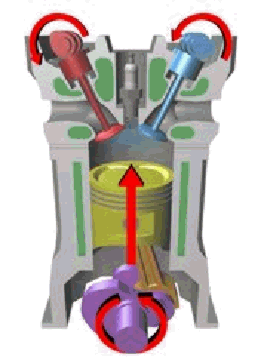
some respects, the body is analogous to an automobile. In the human machine, muscles are both cylinders and pistons, and bones and joints are the gears. The muscles oxidize nutrients (fuel) and give up
energy, while generating metabolic byproducts (waste). Physiology studies this process.
In
some respects, the body is analogous to an automobile. In the human machine, muscles are both cylinders and pistons, and bones and joints are the gears. The muscles oxidize nutrients (fuel) and give up
energy, while generating metabolic byproducts (waste). Physiology studies this process.
Two categories of physiological demands usually are relevant during work: static and dynamic. Static work occurs when the body is in a stationary position for an extended period. Dynamic work involves considerable movement.
The musculoskeletal system isunsuited for prolonged static work because the body cannot supply fresh nutrients to the stressed tissues. In addition, waste products remain at the stressed site. Muscles and tendons can inflame. Even at static loads as low as 30 percent of maximum strength, fatigue develops rapidly.
In dynamic work nutrients and waste products move to and from the muscles. Consequently, the muscles can work for extended periods if the maximum load on the body is significantly less than the maximum static capability.
Endurance usually limits dynamic work when loads are not extreme. Toyota uses this effect by designing workcells that require considerable walking and movement. This reduces static work with a slight increase in dynamic work. There are many other advantages such as allowing work balance through circulation.
Usually, tasks should not require operators to exert more than 30 percent of their maximum muscle force in a prolonged or repetitive way. All muscular exertions beyond 50 percent of the maximum level should be avoided.
Biomechanics
Biomechanics studies the mechanical forces in human movement. Its principles help to minimize damage to muscles, joints, and tissues.
One-time forces that are simply too great for the joint or muscle can create damage. However, workers are usually aware of direct, one-time overloads. The effects are felt immediately, perhaps before damage has occurred. Several factors shown to the right can multiply forces and aggravate damage. The worker is often unaware of these aggravating factors.
Ignoring biomechanical considerations is the most common cause of work-related musculo-skeletal disorders such as Carpal Tunnel Syndrome and tendonitis.
Aggravating Factors
 Extreme
Joint Position- Joints placed in extreme positions or angles amplify many biomechanical forces. Thus a load that seems very manageable to the worker may actually cause serious damage. The worker may not be aware of
this damage until too late.
Extreme
Joint Position- Joints placed in extreme positions or angles amplify many biomechanical forces. Thus a load that seems very manageable to the worker may actually cause serious damage. The worker may not be aware of
this damage until too late.
Repetition- Highly repetitive movements without time for rest and healing can create damage even when the forces are quite small. The worker is often unaware of the damage for days or weeks.
Anthropometry
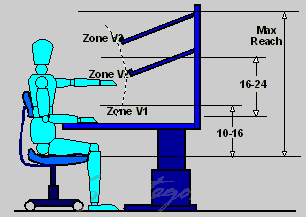
Human dimensions, weights and strengths are the province of anthropometry. Workstation designers need this data to avoid putting workers in risky positions where they must reach too far or sit to low. Such risk positions amplify the forces on the body and increase the probability of repetitive stress disorders. Sometimes risky positions can cause undue fatigue as well.
Humans vary significantly in size and build. In some situations, it is sufficient to design for the smallest or largest likely dimension. In other situations, adjustable benches, chairs or devices are required for the full range of people.
Our page on Selected Anthropometric Dimensions shows some of the more commonly used dimensions as well as the normal ranges.
Allocation of Functions
What should machines do?; What should people do?
These are important decisions in the design of any workstation, manufacturing system or process. Such decisions affect product quality, flexibility, overhead cost, worker health and the economic viability of the process. The list below shows some of the relevant factors for making such decisions.
An Over-Automation Example
In the early days of the Mercury space program, NASA engineers attempted to automate almost every aspect of space flight. The original Mercury 7 astronauts vehemently objected to their proposed role as mere passengers. They called it "Spam In A Can." As a result, Mercury and subsequent manned spacecraft designs assigned significant roles and tasks to the astronauts. The unique value that humans bring to certain tasks was demonstrated dramatically with the Apollo 13 mission.
This is an example of the strong tendency in some organizations to "over-automate" and assign most tasks to use machines. However, insufficient automation is equally ineffective. Much depends on the state of the technology and the relative economics of automation and labor.
People Are Good At-
- Nebulous Information
- Subtle Decisions
- Vague Process Definitions
- Interactions With Other People
- High Variety
- Short Runs
- Varied Cycle Times
- Quick Changeover
- Varied Inputs
- Multiple Work Locations
Machines & Computers Are Good At-
- Quantitative, Accurate Information
- Simple, Straight-Forward Decisions
- Sharply Defined Processes
- No Customer Interfaces
- Repetition
- Short Cycle times
- Long Runs
- High Volume
- High Precision
- Heavy Loads/Large Forces

References & Further Reading
ANSI/HFES100-1988, Human Factors & Ergonomic Society, 1988.
Barnes, Ralph M., Motion and Time Study, Second Edition, John Wiley & Sons, New York, 1940.
Eastman Kodak Company, Ergonomic Design for People at Work, Van NostrandReinhold, New York, 1986.
Fraser, M., The Worker At Work, Taylor & Francis, New York, 1989.
Lee, Q, Nelson W., Amundsen, A., & Tuttle, H., Facilities and Workplace Design, Institute of Industrial Engineers, Atlanta, Georgia, 1996.
Woodson, Wesley E. and Conover, Donald W., Human Engineering for Equipment Design 2nd Rev. Edition, University of California Press, Berkeley, 1966.
Zandin, Kjell B. and Maynard, Harold B., Industrial Engineering Handbook 5TH Edition, McGraw-Hill, New York, 2001.
■ ■ ■ ■ ■ ■ ■

|
The Strategos Guide To Value Stream and Process Mapping goes beyond symbols and arrows. In over 163 pages it tells the reader how to do it and what to do with it. |

The free newsletter of Lean strategy