
A Bomber An Hour
Lean Manufacturing circa 1944
Production Miracle At Willow Run

This article is available free in printer-friendly pdf format.
In January of 1940, America was being drawn into the growing war and our military was woefully unprepared. The Roosevelt administration asked Ford Motor Company to manufacture components for the B-24 Liberator bomber. Charles Sorensen, Vice-President of Production for Ford traveled to San Diego to observe Consolidated Aircraft's operations. Here is his description of the visit and how he conceived the Willow Run bomber plant that eventually manufactured 8,800 of these aircraft.
Willow Run was the physical embodiment of the Ford Production system which was later transformed by Toyota into "Just In Time" and Lean manufacturing. This is where it all started.The narrative below is Sorensen's own account of the birth of Willow Run as told in "My Forty Years With Ford."
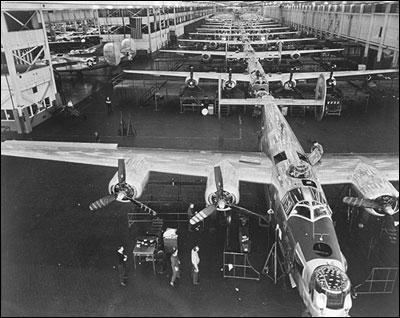
Willow Run became a reality. Here are some of the statistics:
- 488,193 parts
- 30,000 components
- 24 Major subassemblies
- Peak production- 25 units per day
- 25,000 initial drawings
- Ten model changes in six years
- Thousands of running changes
- 34,533 employees at peak
- 100% Productivity improvement
Charlie Sorensen's Story
Inside the (Consolidated) plant I watched men putting together wing sections and portions of the fuselage. The work of putting together a four-engine bomber was many times more complicated than assembling a four-cylinder automobile, but what I saw reminded me of nearly thirty-five years previously when we were making Model N Fords at thePiquette Avenue plant. This was before Walter Flanders rearranged our machines and eight years before we achieved the orderly sequence of the assembly line and mass production.
The nearer a B-24 came to its final assembly the fewer principles of mass production there were as we at Ford had developed and applied over the years. Here was a custom-made plane, put together as a tailor would cut and fit a suit of clothes.
The B-24's final assembly was made out of doors under the bright California sun and on a structural steel fixture. The heat and temperature changes so distorted this fixture that it was impossible to turn out two planes alike without further adjustment. The Consolidated and the Air Force people talked about an order from Ford Motor Company for center and outer wing sections; but it was obvious that if the wing sections had uniform measurements, the way we made parts for automobiles, they would not fit properly under out-of-doors assembly conditions.
All this was pretty discouraging, and I said so. Naturally, and quite properly, the reply was "How would you do it?" I had to put up or shut up. "I'll have something for you tomorrow morning," I said.
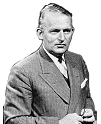
Charles E. Sorensen
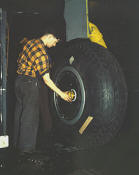
Landing Gear Inspection
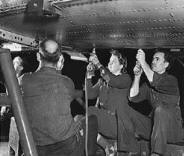
Riveting Lower Wing Skin
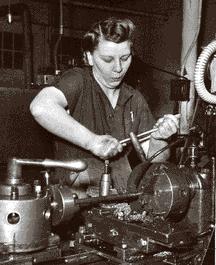
Machinist At
Willow Run
I really did have something in mind. To compare a Ford V-8 with a four-engine Liberator bomber was like matching a garage with a skyscraper, but despite their great differences I knew the same fundamentals applied to high-volume production of both, the same as they would to an electric egg beater or to a wrist watch.
First, break the plane's design into essential units and make a separate production layout for each unit. Next, build as many units as are required, then deliver each unit in its proper sequence to the assembly line to make one whole unit~ finished plane.
To house all this and provide for efficient operation there should be a new plant specially designed to accommodate the progressive layout. I saw no impossibility in such an idea even though mass production of anything approaching the size and complexity of a B-24 never had been attempted before.
But who would accept such a wild notion? And instead of one bomber a day by the prevailing method I saw the possibility of one B-24 an hour by mass production assembly lines. How could the aviation people take that estimate seriously?
As soon as I returned to my room at the Coronado Hotel, I began figuring how to adapt Ford assembly methods to airplane construction and turn out one four-engine bomber an hour.
Throughout the day I had made copious notes. I listed all major units of the plane and the subunits and fractional units required for their assembly, and I had gathered figures on Consolidated's labor force and job performance.
From these I computed each unit operation, its timing, and required floor space as I saw them, and paper began to fly. Figures for each unit I kept together in a separate pile, and soon there were little stacks of paper all over the floor of my room.
I was back at my old game of sketching a series of manufacturing and subassembly operations and their orderly progression toward becoming major units-- a game I had played many times since that morning in 1908 at the Piquette Avenue plant when we first experimented with a moving assembly line.
Now, in one night, I was applying thirty-five years of production experience to planning the layout for building not only something I had never put together before, but the largest and most complicated of all air transport and in numbers and at a rate never before thought possible.
Again I was practicing my production planning philosophy, which stemmed from my patternmaking days when I fashioned wooden models of Henry Ford's half-thought-out designs: "Unless you see a thing, you cannot simplify it. And unless you can simplify it, it's a good sign you can't make it.?
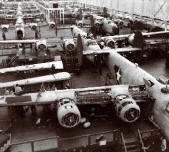
Wing Assembly
Two parallel assembly lines converge after the outer wing is attached.
As I look back now upon that night, this was the biggest challenge of my production career-bigger than any Model T assembly line sequence for Highland Park, more momentous than the layout and construction of the great River Rouge plant in which I'd had a part. It took eight years to develop Ford's mass production system, and eight more years before we worked up to a production of 10,000 cars a day.
Once again I was going on the principle I had enunciated many times at Ford: "The only thing we can't make is something we can't think about."
Through most of the night I set down figures and revised them. I arranged and rearranged the stacks of paper,
as it became plainer to me which unit came after the other in moving to final assembly and how much floor space was involved.
At length the whole picture became clear and simple. I knew I had the solution, and I was elated by the certainty that the Germans had neither the facilities nor the conception for greater bomber mass production.
Towards four o'clock, I was satisfied that my piles of paper were arranged in proper order and represented the most logical progress of units to the main assembly line; and I knew I could prove a construction rate of one big bomber an hour. Now I had something to talk about.
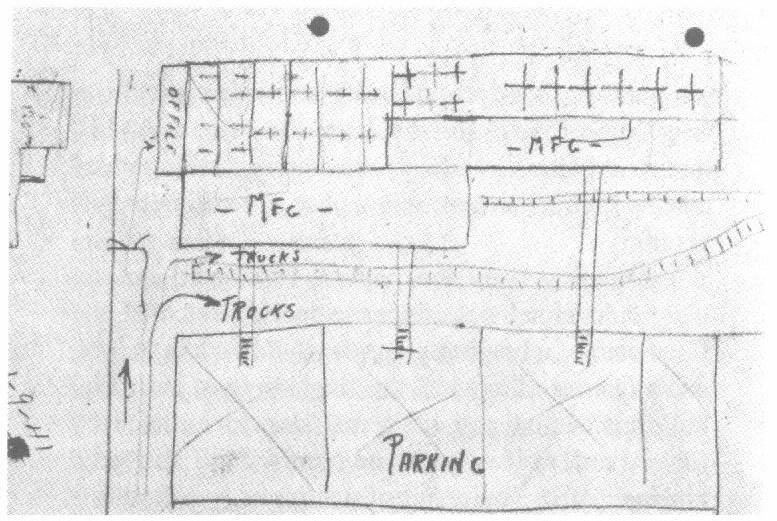
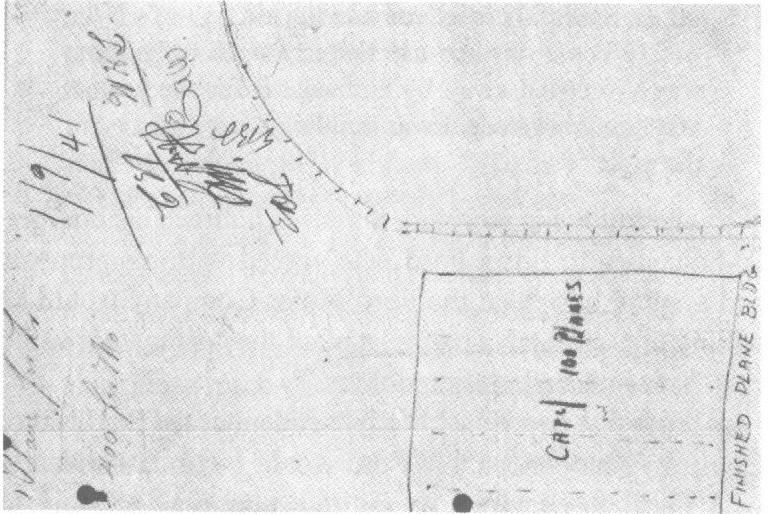
Standing over the papers, I roughed out on Coronado Hotel notepaper a pencil sketch of the floor plan of a bomber plant. It would be a mile long and a quarter mile wide, the biggest single industrial building ever. I still have that sketch, initialed by Edsel Ford, his two sons and others, and I still get a kick out of it.
The result of one night's hard work, it is the true outline of Willow Run, which took two years to build and came through on schedule with one four-engine Liberator an hour, 18 bombers a day, and by the end of the war a total of 8,800 big planes off the assembly lines and into the air.
When I finished my sketch I went to bed, but was so carried away by enthusiasm for the project that I couldn't sleep. I was building planes the rest of the night.
At breakfast with Edsel (Ford) the next morning I was somewhat woozy as I showed him the sketch and outlined the bomber-an-hour proposition.
He was in complete accord and assured me that Ford Motor Company would build such a plant. My high respect for him went higher than ever. We spent an hour together, getting set for a meeting in Major Fleet's office to shoot the works on a $200,000,000 proposition backed only by a penciled sketch.
Charles Sorensen's Original Sketches
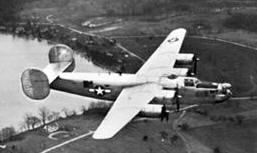
B-24 Test Flight Over Michigan
Albert Kahn, a prominent industrial architect translated Sorensens sketches into bricks and mortar. The final design was L-shaped because of some problems with easements for adjacent property. Willow Run Airport is in the background.

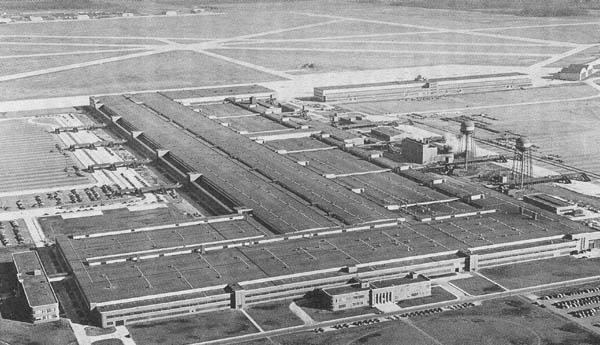
Willow Run Bomber Plant
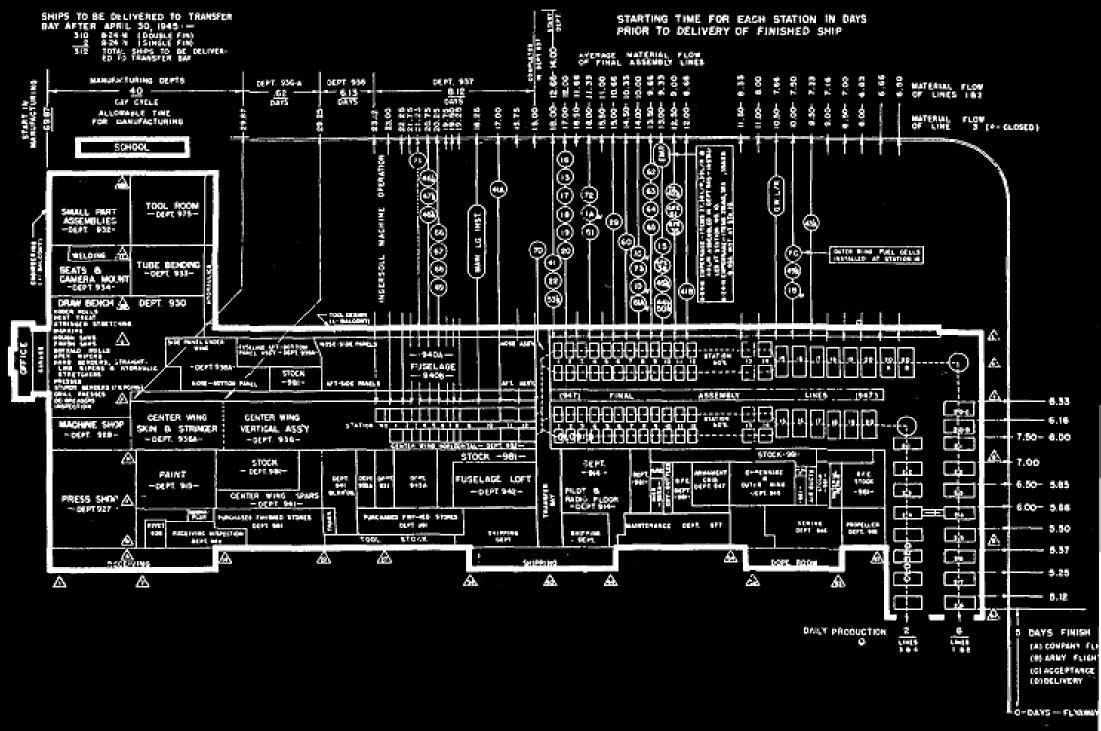
Willow Run Plant Layout circa 1944
References
SORENSEN, CHARLES E., My Forty Years With Ford. New York: W.W. Norton, 1956.
LACEY, ROBERT, Ford: The Men and The Machine, Boston, MA, Little Brown, 1986.
KIDDER, WARREN BENJAMIN, Willow Run: Colossus of American Industry, Lansing, MI, KFT, 1995.
■ ■ ■ ■ ■ ■ ■
|
The Strategos Guide To Value Stream and Process Mapping goes beyond symbols and arrows. In over 163 pages it tells the reader how to do it and what to do with it. |

The free newsletter of Lean strategy