
Warehouse Layout & Design
Transactions, Inventory & Technology


Warehousing was supposed to disappear with Lean Manufacturing. This has rarely occurred but the nature of warehousing often does change from storage-dominance to transaction dominance.
Warehousing buffers inbound shipments from suppliers and outbound orders to customers. Customers usually order in patterns that are not compatible with the capabilities of the warehouse suppliers. The amount of storage depends on the disparity between incoming and outbound shipment patterns. In addition, the trend to overseas sourcing has increased the need for warehousing and its importance in the supply chain.
Design Strategies
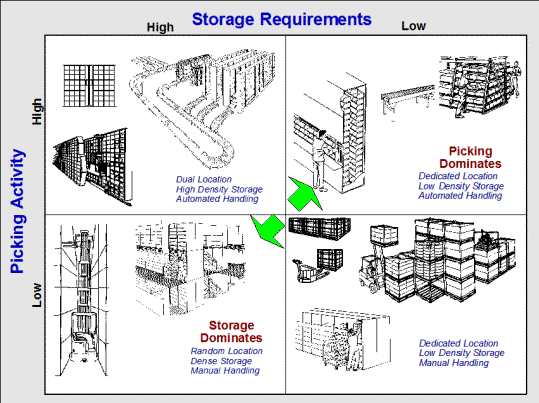
One key to effective design is the relative dominance of picking or storage activity. These two warehouse functions have opposing requirements.
Techniques that maximize space utilization tend to complicate picking and render it inefficient while large storage areas increase distance and also reduce picking efficiency. Ideal picking requires small stocks in dedicated, close locations. This works against storage efficiency.
Automation of picking, storage, handling and information can compensate for these opposing requirements to a degree. However, automation is expensive to install and operate.
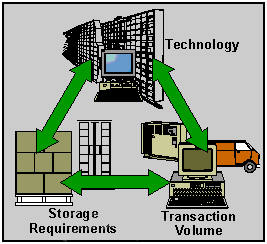
The figure below shows how different transaction volumes, storage requirements and technologies lead to different design concepts.
|
High Pick & High StorageThis indicates a large and active warehouse such as a Distribution Center (DC). In these situations, high technology automated picking combined with mechanized handling and high density storage justifies itself. |
High Pick & Low StorageWith high picking activity but low storage, the picking area should be compact and dense and storage is simple. Some automation of picking may be justified. |
Low Pick & High StorageHere the requirement is for high density storage with high bays, multi-levels and dense packing. Low turnover means that picking can be manual or semi-manual. |
Low Pick & Low StorageA simple, small warehouse requires neither automation or sophisticated storage devices. Stacked pallets, floor storage or simple racks and shelves suffice. Handling is manual. |
For more detail on this issue, see the article on Transaction-Inventory Analysis and the download of NAVSUP 529, the U.S. Navy's comprehensive "Warehouse Modernization and Layout Planning Guide", both written by The Sims Consulting Group, a Strategos-International affiliate.
A well-designed warehouse offers many advantages. It operates with high labor efficiency, minimizes inventory, utilizes space effectively, minimizes errors, and responds to the needs of customers.
 Ed
Phillips has wide experience across many industries from micro-miniature machined parts and
semi-conductors to Boeing 747 aircraft. He is past chairman of the Materials Handling
Engineering Division of ASME and the author of the book "Manufacturing Plant Layout".
Ed
Phillips has wide experience across many industries from micro-miniature machined parts and
semi-conductors to Boeing 747 aircraft. He is past chairman of the Materials Handling
Engineering Division of ASME and the author of the book "Manufacturing Plant Layout".
■ ■ ■ ■ ■ ■ ■

|
The Strategos Guide To Value Stream and Process Mapping goes beyond symbols and arrows. In over 163 pages it tells the reader how to do it and what to do with it. |

The free newsletter of Lean strategy