Strategos Books & Videos

The Strategos Guide To Value Stream & Process Mapping Facilities Planning & Workplace Design

Warehouse Modernization & Planning Guide The Human Side of Lean Video

Strategic Implications

Strategic Implications of Variability & Little's Law

just in time production

Lean Resources

Home
Resources
Site Guide
Lean Training
Book Reviews
Useful Links
Search Site
About Strategos


China

Lean Manufacturing Academy

Europe

Jung, Aust & Partner

Australia

Peter J. Ellis

North America

Sims Consulting Group

Strategic Impact


______________


Download

Expanded & printer friendly version of this series


Manufacturing Strategy

The conventional wisdom of accounting considers excess capacity as waste. However, reserve capacity may reduce other forms of waste. These are strategic issues that require considerable reflection at the highest levels.

The sections below illustrate a few of the ways that variability, capacity and Little's Law affect the development of an effective Manufacturing Strategy.

Finance

Capital Investment

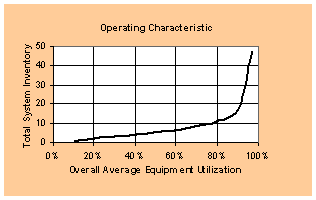
Many firms require very high utilization rates before authorizing investment for additional capacity. This is unwise if higher utilization increases inventory more than the additional capacity cost.

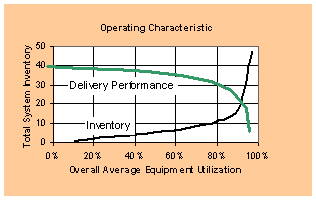
Such policies may also work against marketing strategies that depend on delivery performance. Before implementing high utilization policies, management should consider not only the total investment (including inventory) but also the effect on marketing.

In addition, utilization policies should distinguish between low cost equipment that needs only low utilization rates and high cost equipment.

Cost Structures

Conventional costing systems may not accurately distribute the cost of variability created by a wide product mix. The cost of this variability often appears in overhead accounts that are allocated in distorted ways. For more on this, see "Product Costing" and "Lean Accounting."

This also relates to marketing strategy as noted below.


Marketing

Customer Needs

Since high utilization is generally incompatible with high variability and low inventory, priorities for these variables should be established. The key is to clearly identify the customer's buying decision criteria.

When most customers buy only on price, this indicates that low-cost production has the highest priority. Low cost production indicates maximum utilization of capital. It might also indicate the use of backlog to achieve steady throughput. Both of these approaches increase throughput time and affect delivery adversely.

When delivery is the primary decision criteria for customers, excess capacity, low inventory and minimal backlog is the best approach. However, these strategies may increase cost.

"Build It and They Will Come"

Policies that prevent capacity investment until demand is proven often inhibit growth. New capacity requires time to commission and customers will rarely wait.

Companies that build capacity in anticipation of growth usually find that their new capacity attracts growth. Future pages will address these issues of capacity planning and strategy.

Product Variety

Increasing the product offering is a common marketing strategy. However, additional products rarely increase sales volume in  proportion their number.

The result is a product mix with a few high-volume products and many low volume products. This brings further consequences, such as:

  • The additional variety increases overall cost, primarily in overhead.

  • The costing system may not accurately distribute the additional cost and under-price the low volume items.

  • The additional variability may increase inventory and adversely affect delivery performance.

When considering new products, executives should consider the effects of such product proliferation.

Embracing Variability As A Strategy

A few, rare firms embrace variety as a successful business strategy. Some offer a wide and constantly renewed product mix that competitors cannot match. Others specialize in unusual, custom products that command high prices.

However, to be successful in this, firms must gear their order processing and manufacturing to coping with such variety (see below). This is difficult, but, when successful, highly profitable.


Manufacturing

Strategies for Variability

Manufacturers can either 1) reduce variability or 2) cope with it. Almost every element of Lean Manufacturing aims at reduction, coping or both.

Most variability is unnecessary, unproductive and indicative of an underlying problem. For these reasons, variability reduction is the first line of defense. TQM/Six Sigma is an example of variability reduction.

Occasionally, variability is irreducible for technical reasons or desirable for marketing reasons. In these cases, systems can be designed to cope with it. CNC processing equipment is an example of coping with variability. However, coping with variability (as opposed to reducing it) is often expensive and may produce have consequences.

Almost every aspect of Lean Manufacturing involves variability. Some elements of Lean reduce variability while others attempt to cope with irreducible variability. For more on  this, see "Variability and Lean Manufacturing."

Embracing Variety and Variability

Coping effectively with variability can lead to an effective marketing strategy. Such strategies are quite difficult, but, when mastered, are also quite effective. Competitors simply cannot develop the ability to compete on this dimension. Variability as strategy usually takes one of two forms:

  • Offering a wide range of products often with many new and different products.

  • Offering to supply large orders, custom products or special projects on short notice.

The first approach requires high competence in product development and product introduction as well as high flexibility in manufacturing.

The second approach requires the maintenance of excess, idle capacity. When an order or project arrives, manufacturing can produce it quickly. Such idle capacity incurs cost and such strategies are only effective when pricing and margins compensate for this additional cost.

Capacity, Inventory & Variability Series

Variability Effects
Strategic Implications
Lean & Variability
Capacity & Inventory

References

Sterman, John D., Business Dynamics: Systems Thinking & Modeling for a Complex World, Irwin McGraw-Hill, New York, 2000.

Hopp, Wallace J. and Spearman, Mark L., Factory Physics, Irwin McGraw Hill, New York, 1996.

Forrester, Jay Wright, Industrial Dynamics, Pegasus Communications, (1961)

Stalk, George, Competing Against Time, Free Press, 2003.

Blackburn, Joseph D., Time-Based Competition, Business One Irwin, 1991.


Subscribe to Lean Briefing-- The Free Newsletter of Lean Manufacturing Strategy

First Name: Last Name: Email:

Lean Briefing is sent about every month. You may "unsubscribe" at any time.

We will NOT: Sell this information, transfer it, bombard you with Email, or otherwise abuse your trust

Home ] Resources ] Site Guide ] Lean Training ] Book Reviews ] Useful Links ] Search Site ] About Strategos ]

Email: info1@strategosinc.com          Phone: 816-931-1414

Strategos-International:  China - Europe - Australia - North America