
Toyota Production System (TPS) & Lean
A Brief Overview
The Toyota Production System (TPS) combines attitudes, themes and specific techniques into an integrated socio-technical system for manufacturing. Taiichi Ohno, Shigeo Shingo and Eiji Toyoda originally developed it between 1948 and about 1975. (For more on this, go to "A Brief History of Just In Time.")
As TPS spread through Japan and, eventually, to the West, it acquired other names and variations. Toyota itself did not have a name for their manufacturing strategy until the 1970's.
Just In Time, World Class Manufacturing, Stockless Production, Demand Flow Technology and many other terms are, essentially, variations of Toyota Production. Lean Manufacturing, coined by James Womack, is the moniker that seems to be sticking.
When well done, TPS brings order of magnitude improvements in material handling, inventory, quality, scheduling, and customer satisfaction. The payoff to shareholders is significant and well documented.
Overall Themes
Elimination of Waste ("muda" in Japanese) has many forms. Material, time, idle equipment, and inventory are examples. Most companies waste 70%-90% of their available resources.
TPS emphasizes the identification of waste (often problematic) followed by specific tools and techniques to eliminate it.
Inventory
Inventory is one of the largest wastes. It devours capital, becomes obsolescent and consumes space and manpower while just sitting. Inventory also hides other waste.
Almost every imperfection or problem creates a need for inventory. Inventory is, thus, an effect as well as a reflection of overall manufacturing effectiveness.
People
Factories include people. To function well, people and technology must integrate in a system exploiting the strengths and minimizing the limitations of each component. Eric Trist called this a Socio-Technical System.
TPS emphasizes the participation of all employees. It uses teams integrated with work cells for motivation, work management and problem solving.
Systems Thinking
The tools and techniques are highly interdependent. Each acts upon and improves the others in a continuous "Virtuous Circle". Results for the system are greater than the separate effects.
Core Disciplines
Most waste is invisible and elimination is not easy. Toyota developed a set of techniques that identify and eliminate waste in their context. Among them:
►Six Sigma/Total Quality Management
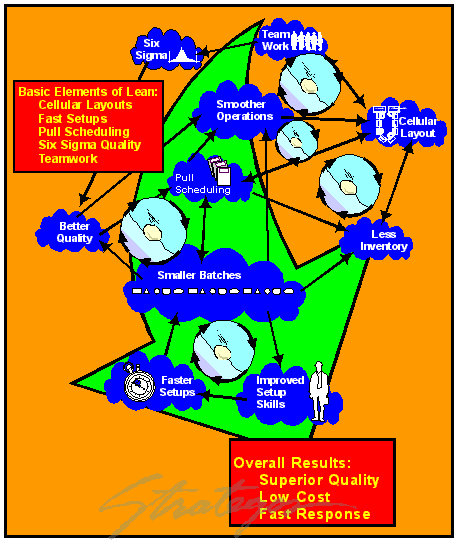
This graphic shows how these elements work together with mutual reinforcement. Each arrow indicates a positive influence or relationship. For example, Fast Setups enable small batches, and small batches result in smoother material flows. Note the large number of circular loops that drive the system to higher and higher levels of performance-like a snowball rolling downhill. (Thus the "snowball" icon)

Non-Manufacturing
The principles of Toyota Production System apply to any work process. Many specific techniques apply as well.
Non-manufacturing work differs only in that the "workproduct" is often invisible. Non- manufacturing activities offer even more potential benefits than manufacturing.
Implementation
For many firms the implementation of TPS is fraught with as many hazards as opportunities.
"...the tools and artifacts were developed to deal with very particular problems that were affecting people in very particular circumstances. Working under different circumstances presents different problems, which requires different tools and different thinking." So says Steven Spear of Harvard who wrote "Decoding The DNA of the Toyota Production System."
Summary
The Toyota Production System has been highly successful for Toyota, Toyota's suppliers and many other firms. It is often a good starting point but rarely a substitute for an individualized, well-thought-out Manufacturing Strategy.
■ ■ ■ ■ ■ ■ ■

|
The Strategos Guide To Value Stream and Process Mapping goes beyond symbols and arrows. In over 163 pages it tells the reader how to do it and what to do with it. |

The free newsletter of Lean strategy