
The Psychology of SPC
For Low-Tech Firms, Psychology Dominates
The Issue
Statistical Process Control (SPC) is often thought of as a technical and scientific discipline that applies to sophisticated, high-volume processes. Many people also assume that SPC is a technical approach and operators play only a supporting role. By extension, Total Quality Management (TQM) and Six Sigma are thought of in the same way since both use SPC as a primary tool.
The assumptions above are incorrect. SPC works equally well with simple manual operations such as bench assembly. It also has a strong psychological component that mentally sucks workers into the process even if they are not ordinarily inclined to participate. It can work wonders with processes that have:
- Low volume
- High Variety
- Manual Operations
- Primitive Technologies
- High Operator Dependence
This article illustrates the above points and tells how a manufacturer of commercial windows reduced final assembly defects by over 90% in about seven weeks.
The Situation

The company manufactured a wide variety of aluminum windows for hotels and other commercial buildings. They had implemented workcells and each workcell built several basic models. However, every window was made to custom dimensions and there were thousands of variations on each model.
The process consisted of manual assembly with simple hand tools by a team of operators. They gathered parts that had been fabricated in other departments and assembled the windows on workbenches in accordance with the engineering documents. Quality depended primarily on operator experience and awareness.
Inspectors conducted 100% final inspections, primarily visual, with a few simple aids such as a scale. Defects might include missing parts, crooked parts or insufficient sealant.
|
In a comical twist it came to light that one inspector could not read an ordinary document because of an outdated eyeglass prescription. |
The quality performance was poor. At times, over 50% of the windows built had one or more defects. Even with 100% inspection, inspectors *missed many defects that later required expensive field correction.
The Solution
All operators received training in basic SPC with emphasis of the simple methods such as "Pareto Charts," "P-Charts" and "N-Charts." They also received training in basic problem-solving methods.
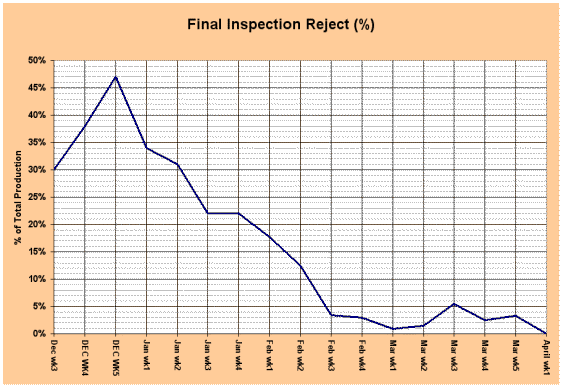
Cell teams recorded their own data as each day progressed. Weekly meetings were held to review trends and resolve repetitive issues. Each team became responsible for their own inspection and the former inspectors became consultants and auditors of the teams. Operator response was excellent. The "P-Chart (right) shows the results.
The Results
Defects dropped from 47% to about 3% over a seven-week period. The trend indicated that the eventual defect rate would probably approach 0.0%.
This improvement was almost entirely due to psychological factors. Virtually no changes were made in process technology (benches and hand tools) and management made no changes or efforts in the upstream operations that supplied components during this period.

Reasons For Success
Feedback- Most people want to do a good job. The problem comes when people have no objective information to tell them what good performance means and when they have achieved it. Or, they receive the information too late to correct performance.
Awareness- Studies during World War II showed that a fighter pilot's ability depended most on what was called "Situational Awareness." This is an intangible, often unconscious, quality. It refers to the ability of the conscious and unconscious mind to pay attention to surroundings and react accordingly. Simple SPC charts and training increases operator's situational awareness in this respect.
Involvement- When people are involved in their work they generally exhibit higher motivation.
Recognition- Management paid considerable attention to the charts and recognized everyone's efforts. This is a simple, powerful but oft-neglected tool. The famous Hawthorne experiments at Western Electric in the 1930's demonstrated that attention paid to work groups brings positive results.
Communication- There is evidence that cell operators made special efforts to communicate their needs to operators at the upstream operations and thereby reduced incoming defects. This operator-to-operator communication was more effective than similar communications from management had been.
Conclusions
- SPC exerts powerful psychological effects even with no change to the process technology.
- SPC can be highly beneficial in conventional, manual operations such as bench assembly.
- Six Sigma and TQM leverage these psychological effects.
SPC, TQM and Six Sigma is not just for high-tech operations. It can help improve quality and productivity in almost any process. Please call us to discuss how it might apply to your operation.
Related Information
■ ■ ■ ■ ■ ■ ■

|
The Strategos Guide To Value Stream and Process Mapping goes beyond symbols and arrows. In over 163 pages it tells the reader how to do it and what to do with it. |

The free newsletter of Lean strategy