
Volume, Variety & Product Costing
How to Make Money and Then give It Away
 Product
costing is one of the most problematic issues in lean accounting. This is especially true when a
wide variety of products and a wide range of volumes exist in the same factory. Simplicity
Electronics is a mythical but typical company that illustrates.
Product
costing is one of the most problematic issues in lean accounting. This is especially true when a
wide variety of products and a wide range of volumes exist in the same factory. Simplicity
Electronics is a mythical but typical company that illustrates.
Our analysis derives directly from Simplicity's standard financial statements, sales data and some common-sense estimates. You can do a similar analysis for your own company.
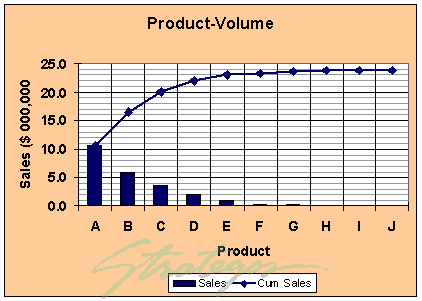
Chart 1 Products and Volumes
We start with annualized sales volume, by product. Simplicity has ten products, as shown in the Product-Volume chart. This chart shows the sales for each product with a bar and cumulative sales with a line.
Like most manufacturers, Simplicity has a few products that account for the majority of sales and many low-volume products representing a small part of sales (Pareto's Law).
This sales information is, usually, readily available and accurate.
For conceptual purposes, assume that the products are similar in work content, material content and price. The gross margins on each product are also similar.
Total sales are $24,000,000 as the income statement shows.
Product Costs

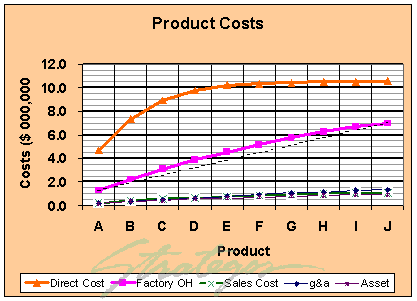
Chart 2 Product Costs
In Chart 3, we show product cost. Moving from left to right, each additional product adds cost. The end point of each line corresponds to a cost on the income statement.
Direct Cost (Red)-- This is the sum of direct materials and direct labor. Since products and margins are similar, these costs increase in proportion to sales and the curve parallels the sales curve in Chart 1. The total is $10,500,000.
Factory Overhead (Purple)-- Here, the trouble starts. Traditional accounting systems allocate overhead with a simple formula, often based on direct labor. If this were correct, the overhead curve would mirror the sales and direct cost curves.
For a variety of reasons, low volume products attract far more overhead activity per unit than do high volume products. (see examples at "Why Low Volume Costs More).
One can well argue that the factory overhead curve should be a straight line or even a line with increasing slope.
To be conservative, we assume a somewhat linear curve that partly parallels direct cost. We know the starting point ($0.00) and the endpoint ($6,300,000) from the income statement. These final numbers are usually reliable, only the shape of the curve between them is open to question.
Sales Cost--These are the costs of sales salaries, commissions, advertising and other sales-related activities. These costs must also be added to each product cost. The rationale is similar that for factory overhead.
G & A--This is corporate administrative costs and other overhead not directly related to the factory. The total is $1,400,000 and the shape of the curve is similar to factory overhead.
Asset Cost-- This is the cost of assets used, directly or indirectly, for the product. It includes inventory, equipment and facilities. We estimated 6% per year and allocated the assets similar to overhead. The total is $1,000,000.
Note that 50% of the total cost is allocated rather than collected directly. In addition, the allocation is made on a component representing 20% of the total cost. In most companies, the allocated portion is even higher.
Profitability
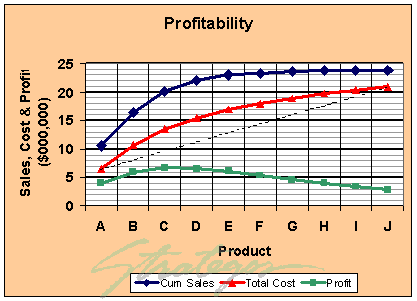
Chart 3 Profitability
Our next chart shows the profit (before taxes) with increasing product variety. Profit equals cumulative sales (blue) minus cumulative product cost (red). The total product cost in Chart 3 is the sum of all costs in Chart 2 at each point.
Note that the profit curve peaks at Product C. Only Products A, B and C are profitable! Products D and E almost breakeven and the remainder lose money.
Simplicity Electronics makes a lot of money ($6,600,000) on three products and then gives over half of it away on six low volume products.
This is not an exact analysis and the precise breakeven point might be questioned. However, there should be no doubt that at least 3-4 of the lowest volume products are money losers.
Actions To Take
Simplicity should either:
-
Drop the low volume product lines.
-
Adjust pricing and margins on all products to cover the true cost.
Beyond that they might use separate focused factories for high and low volume to isolate the true costs and promote better efficiency for all products.
Full Product Line Argument
But what about the argument, usually from sales, that the low volume products are necessary to fill out the product line?
This argument is often not valid because the low and high volume products are in different market segments with different customers, The proposition is easy to test. Analyze a random sample of sales orders and determine how many customers order high and low volume items on the same order. Having "loss leaders" in a product line is not necessarily bad, provided that management knows they are loss leaders. It is doubtful that Simplicity's managers knew they were spending over $3,000,000 on loss leaders.
The Death Spiral of Overhead Cost
Such overhead distortions often lead companies into a slow death spiral of decreasing profitability. I have been personally involved with several such situations. A future article will elaborate.
Download the Simplicity Electronics spreadsheet. It can be a model for your own analysis.
Thanks To Hal Mather
This analysis derives from a memorable presentation Hal Mather gave several years ago.

■ ■ ■ ■ ■ ■ ■

|
The Strategos Guide To Value Stream and Process Mapping goes beyond symbols and arrows. In over 163 pages it tells the reader how to do it and what to do with it. |

The free newsletter of Lean strategy