
Lean Manufacturing As A System
the "Systems thinking" Perspective

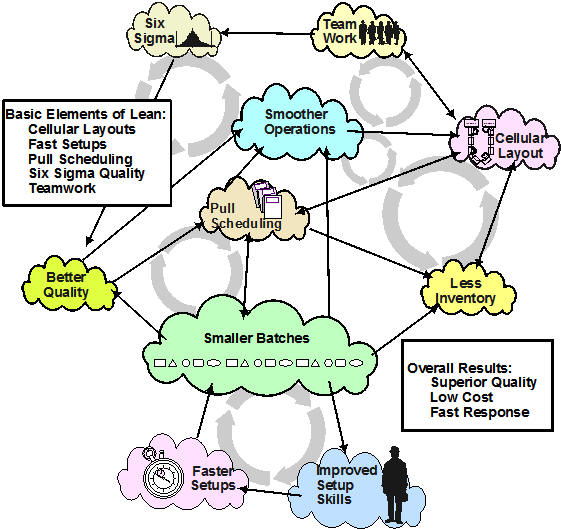
Lean Manufacturing systems have interrelated elements that form a system or Manufacturing Strategy. The graphic shows how these elements work together and reinforce each other. Each arrow indicates a positive influence or relationship. For example, Fast Setups enable small batches, and small batches result in smoother material flows. Note the number of circular loops. Such loops continuously reinforce each other driving the system to higher and higher levels of performance--like a snowball rolling downhill.
These effects are part of a body of knowledge known as "System Dynamics", "Industrial Dynamics", or just "Systems Theory". A factory system has both technical and human elements which immensely complicates theoretical analysis. Moreover, such systems may exhibit very strange behavior such as instability and chaos. Lean Manufacturing addresses many of the elements that reduce chaotic effects such as variability, time delays and complexity.
It is difficult to study such systems directly since their complexity makes modeling
difficult. Our understanding generally comes from working with simpler models and extrapolating
the results through intuition and general principles. For a complete discussion of these systems
and related phenomena, go to "Principia
Cybernetica Web".
■ ■ ■ ■ ■ ■ ■

|
The Strategos Guide To Value Stream and Process Mapping goes beyond symbols and arrows. In over 163 pages it tells the reader how to do it and what to do with it. |

The free newsletter of Lean strategy