
Lean Manufacturing Leadership
Leadership Levels & Issues
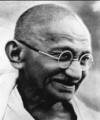
Great Leaders- Mahatma Ghandi
Issues and Problems
For most organizations, problems prevent the direct, linear achievement of a goal. The tasks for accomplishment may be murky and solutions to problems may be unclear. Moreover, the goal itself may be unclear, unknown or controversial.
The problems faced by an organization may be adaptive in nature. Adaptive problems require changes in organizations structure, behavior, values, culture or objectives. Non-adaptive problems simply require the application of existing approaches.
The people who should be involved in problem-solving varies. It depends on the problem and on the available solutions.
Table 1 summarizes several types of problem-solution complexes and the people that should be involved in their resolution. These various problem-solution combinations require different levels of leadership.
Table 1-- Organizational Issues
| Problem/Issue Types | Solutions Available | People Involved |
|
Adaptive, Non-Technical & Unclear |
Unknown and Unclear; Requires Evolution of Values and Innovation |
All Stakeholders |
|
Non-Technical but Clear |
Partly Known -Some Adaptive Learning Required |
Experts Aid Diagnosis; Group Solves Problem |
|
Technical & Clear |
Technical, Solutions Exist |
Expert-Leader Solves Problem |
Levels of Leadership
Table 2 summarizes one perspective on leadership. It views leadership at different levels: Transactional, Relational, Transformational and Charismatic. Clicking on each the level below takes you to further discussion of that leadership level.
If we map the leadership levels of table 2 to the issue types of table 1, we see that lower levels of leadership can cope with technical and non-adaptive problems. Murky, adaptive issues require higher levels of leadership.
Different writers and researchers attach different meaning to these terms. For example, some writers view charismatic leaders as any leader possessing charisma. Others view charismatic leaders as transformational leaders with the added characteristic of charisma.
When viewing these pages and the other literature, you must infer from the context whether the discussion is about the pure Charismatic or Transformational- Charismatic Leader.
Table 2-- Levels of Leadership
| Level | Activities & Competencies | Personal Characteristics | |
|
IV |
Charismatic- Transform- ational (Click for More ..) |
--All of Level III +... --Personal Charisma |
-All of Level III +... -Self-Confident -Knows Him/Herself -Eloquent -Free of Internal Conflict -Expressive Emotionally |
| III |
Transform- ational |
--All of Level II +... -Frames Holistic Issues -Sets New Goals & Direction -Creates Meaning -Manages Creative Conflict -Promotes Organizational Learning -Creates A Context for Dialogue -Manages Paradigms -Creates Commitment Through Shared Values |
-Assertive -Seizes Opportunities -Tolerates Risk -Uses Systems Thinking |
| II |
Relational |
-Creates Commitment Through Participation -Motivates Intrinsically -Promotes Teamwork -Manages Politics -Works Within Existing System |
-Participative & Consultative |
| I |
Transact- ional (Click for More ..) |
-Accepts Organizational Goals -Uses Extrinsic Motivators -Works Within Existing System -Takes Action |
-Directive -Dominating -Action-Oriented |
Transactional Leadership
Activities & Competencies
Transactional leaders use conventional reward and punishment to gain compliance from their followers. They have continuing, often unspoken interaction that take such forms as:
"Do as I say and you will get a raise."
"Meet this quota or you will get fired."
These are extrinsic motivators that bring only minimal compliance from followers. Some followers will supply their own internal (intrinsic) motivation such as pride in their work, but this is a matter of chance.
Transactional leaders accept the goals, structure and culture of the existing organization. They must do so because this type of leadership is ineffective at bringing significant change.
Personal Characteristics
Transactional leaders tend to be directive and sometimes dominating. They tend to be action oriented.
Some transactional leaders adopt this approach because they are unaware of the effect it has on followers. Others may take pleasure in it.
 Application Level
Transactional Leadership is the lowest level. It works only where the organizational problems are simple, clear and technical in nature.
Transactional leadership has often been associated with the military. However, successful militaries have long known that it is ineffective.
Of course, every formal leader uses transactional leadership at times. In certain situations it is necessary and effective.
Relational Leadership
Activities & Competencies
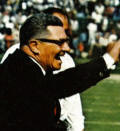
Great Leaders- Vince Lombardi took the Green Bay Packers from perennial losers to the Superbowl.
Relational Leaders create commitment through participation in work and problem-solving processes. This contrasts with the Transactional Leader who gains only compliance.
Teams and teamwork play a key role for the Relational Leader. Belonging to a team is powerful motivation for most people. In addition, teams are better at solving difficult, unclear and non-technical problems.
The Relational Leader manages politics within his/her own team and also with the outside world. This further promotes team effectiveness. Relational Leaders generally work within the existing organization structure and culture. They adopt existing values, goals and processes.
Personal Characteristics
Relational leaders are usually personable. They welcome participation and consultation and will tolerate opposing views.
Application Level
Relational Leadership works well with technical and non-technical problems where the issues are clear. It is insufficient for adaptive problems.
Transformational Leadership
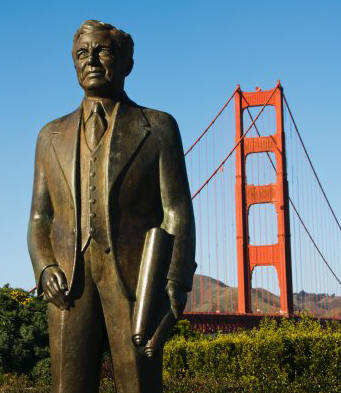
Great Leaders-Joseph Strauss, "The Man Who Built The Bridge"
Activities & Competencies
Visionary, inspiring and daring are words that describe the Transformational Leader. These are the people that revive failing companies. They lead other firms into a future that is very different than their past.
Transformational Leaders have lofty goals and high ideals. They are seen as people of high integrity.
Relational Leaders gain commitment through participative problem-solving. Transformational Leaders creates even greater commitment through shared values in addition to participation.
This sort of transformation requires a wide-ranging re-examination of the organization's purpose, structure and culture by many individuals and groups within. Such re-examination requires discussion and serious debate. People do not accept new values just because the leader tells them to do so.
The Transformational Leader guides this debate. He/she establishes the context and rules for constructive conflict and dialogue. In hundreds of places and thousands of meetings, people begin to operationalize new values.
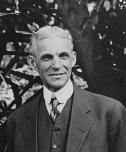
Great Leaders- Henry Ford put the world on wheels.
Personal Characteristics
Transformational Leaders are assertive risk-takers who seize opportunities. They are also systems thinkers who understand the interactions of people, technology and culture.
Such leaders often have an additional trait which we will consider separately: personal charisma.
Application Level
Transformational Leadership lends itself to the most difficult, complex and vague organizational problems. These are the adaptive problems that require re-thinking of the organization's structure, values and culture.
Charismatic Leadership
What Is Charisma?
Charisma (defined in the box) is an elusive, personal quality that involves not just the leader but also the follower's perceptions. Hence we must examine the follower's reactions to adequately identify the Charismatic Leader.
It is emotional in nature. Followers believe in the leader, his/her values and goals, primarily on an emotional basis. Rationality takes a back seat.
Activities & Competencies
Our discussion here is about the Charismatic- Transformational Leader. Such leaders have all of the qualities of the Transformational Leader with the added qualities of the Charismatic Leader.
|
Charisma--A spiritual power or personal quality that gives an individual influence or authority over large numbers of people. Random House Unabridged Dictionary |
Personal Characteristics
Charismatic leaders have a deep self-confidence derived from self-knowledge. They have thought things through and have little inner conflict or doubt.
Application Level
Charismatic-Transformational Leadership applies to the most difficult and complex organizational problems. These problems involve culture, values and paradigms in addition to the more technical problems.
Argyris, C. and Schon, D., Organizational Learning. Reading, Massachusetts, Addison-Wesley, 1978.
Avolio, B.J. and Bass, B.M., "Charisma and Beyond", J.G. Hunt (ed), Emerging Leadership Vistas. Elmsford, N.Y.., Pergamon Press, 1987.
Bass, B.M., Stogsdill's Handbook of Leadership., New York, Free Press, 1981.
Bass, B.M.,Leadership and Performance Beyond Expectations. New York, Free Press, 1985.
Burns, J.M., Leadership. New York, Harper & Row, 1978.
House, J.A., "A 1976 Theory of Leadership", J.G. Hunt (ed),Leadership: The Cutting Edge. Carbondale, Illinois, Southern Illinois University Press, 1977.
■ ■ ■ ■ ■ ■ ■

|
The Strategos Guide To Value Stream and Process Mapping goes beyond symbols and arrows. In over 163 pages it tells the reader how to do it and what to do with it. |

The free newsletter of Lean strategy