
Harley-Davidson's Crises of 1981
Surviving & Thriving During Crises
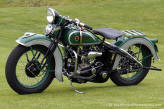 Harley-Davidson
is king of the road these days. But in 1985 the venerable firm was hours from bankruptcy. A
combination of management errors, Japanese competition and recession was about to do in the last
American manufacturer of motorcycles. The company was rescued at the last minute by a
sympathetic investor and a well executed version of Lean Manufacturing.
Harley-Davidson
is king of the road these days. But in 1985 the venerable firm was hours from bankruptcy. A
combination of management errors, Japanese competition and recession was about to do in the last
American manufacturer of motorcycles. The company was rescued at the last minute by a
sympathetic investor and a well executed version of Lean Manufacturing.
The Harley Davidson Story
Founded in 1903, Harley-Davidson became a leader in motorcycles after the first world war. In 1953 their only domestic competitor went out of business and Harley owned the American market until the 1960s when English, German and Italian manufacturers were their only competition.
In 1965 the founding families took the firm public and it was bought by AMF in 1969. AMF provided stability and capital but there were mistakes. AMF built a new assembly plant for Harley-Davidson in York, Pennsylvania and invested heavily in an MRP production control system. These efforts added $1000 to the cost for each bike and AMF pressured Harley to increase production to compensate. Quality suffered and there were chronic shortages of parts. As many as 30 percent of the vehicles coming off the assembly line were incomplete. This, in turn, meant extra manpower searching for parts to finish the machines. Dealers sometimes had to complete the assembly or repairs.
Japanese competitors took advantage of the situation. In 1969 Harley had an 80% market share for super heavyweight machines but this dropped to 20% ten years later. A recession in 1981 reduced sales nation-wide and further reduced Harley's market share. British motorcycles were driven from the market and Triumph collapsed.
AMF wanted out. A management team from Harley-Davidson arranged a leveraged buyout with the help of Citibank and took control in June of 1981. But, there were more problems to come.
The Japanese manufacturers unloaded their inventory and cut prices further. Then, Harley won an anti-dumping judgment from the International Trade Commission (ITC). Tariffs on Japanese bikes increased to 49.4% for five years. The Japanese response was to build more motorcycles in the U.S.
In 1984 Citibank became nervous about another recession and the coming end to increased tariffs. They made financing more difficult for Harley and it was clear they wanted out. Other banks followed Citibank's lead and refused financing. Just hours before bankruptcy, a private investor saw the potential in Harley and bought out Citibank's financing at an $18 million loss to Citibank.
Lean At Harley
Something had to be done--fast and cheap. Harley put together a Lean manufacturing strategy that emphasized employee involvement, Just-In-Time delivery (called MAN for Materials As Needed) and Statistical Process Control. The plan was well-thought-out, well-executed and successful.
At the York facility, bikes were traditionally made in large batches; MAN stabilized schedules and conditioned suppliers to deliver more frequently. Harley had previously held four weeks of stock at a cost of $25 million a year. Now it carries no safety stock; if there is a problem and parts are short, production halts.
Results
By 1986 Harley-Davidson's share of the U.S. super heavyweight market was at 33.3 percent, ahead of Honda for the first time since 1980. In 1987, one year before the tariffs on Japanese motorcycles were scheduled to end, Harley announced they no longer needed special tariffs to compete. In April 1998 Harley announced record sales and earnings--for 32 consecutive quarters of growth. As of 2007, Harley-Davidson continues to run neck and neck with Honda in unit sales for all categories with shares of 27% each.
These days no self-respecting yuppie or Hell's Angel wants to be seen on a Japanese bike.
References & Further Reading
SORENSEN, CHARLES E., My Forty Years With Ford. New York: W.W. Norton, 1956.
LACEY, ROBERT, Ford: The Men and The Machine, Boston, MA, Little Brown, 1986.
LEFFINGWELL, RANDY, Harley-Davidson History & Mystique, Crestline, St. Paul, MN, USA, 2003

■ ■ ■ ■ ■ ■ ■
|
The Strategos Guide To Value Stream and Process Mapping goes beyond symbols and arrows. In over 163 pages it tells the reader how to do it and what to do with it. |

The free newsletter of Lean strategy