
Cycle Counting & Inventory Record Accuracy
The Lean Side of Cycle Counting
What Is Inventory Record Accuracy?
 Inventory
Record Accuracy (IRA) is a measure of how closely official inventory records match the physical
inventory. Many managers equate Inventory Record Accuracy with cycle counting, but there is a
lot more to it.
Inventory
Record Accuracy (IRA) is a measure of how closely official inventory records match the physical
inventory. Many managers equate Inventory Record Accuracy with cycle counting, but there is a
lot more to it.
The units of measurement are either dollar based or count based. These two bases have different purposes and may give widely differing results. Accountants and financial auditors prefer dollar-based measurements of accuracy. Their concern is to ensure that the inventory value stated on books and tax returns is accurate at an aggregate level. Discrepancies on individual items hold little concern provided that positive and negative discrepancies are roughly equal and the total value is the same.
Operations and material management people have a stronger interest in the accuracy of individual SKUs. If one SKU is short, they can rarely substitute some other part or item that happens to be long.
Why Is It Important?
The reasons for having accurate records are legion. Here are a few of them:
Financial Reasons:
-
Investors want to know that the book value is accurate.
-
Lenders who loan money with inventory as collateral want to protect their loan.
-
Taxation often depends on inventory value. Overpayment of taxes reduces profits and underpayment incurs penalties.
-
Poor accuracy begets more inventory and requires more capital. Inventory is often the largest consumer of capital for an enterprise.
Operational Reasons:
-
Stockouts interrupt production and create delivery delays.
-
People waste hours looking for misplaced or missing items.
-
When stockouts are frequent, inventory rises to compensate. This unnecessary inventory requires space and capital.
-
Inventory turnover reflects overall manufacturing efficacy.
-
MRP and ERP systems require very high accuracies (95%-99%) to function well.
-
Stockouts increase cost in a hundred ways and sap the time and energy of everyone.
 IRA & Lean Manufacturing
Lean Manufacturing reduces the need for inventory and transaction volume. It makes high accuracy easier. However, this takes many years and Inventory will be with us for a long time.
The stockouts common to firms with poor accuracy generate significant fears throughout the organization and create complications for a lean implementation. Because of this, increasing inventory accuracy may be a necessary part of a lean manufacturing strategy.
Reasons For Inaccuracy
There are many causes for inaccurate records. People may enter data inaccurately or not at all. Confusing location codes cause discrepancies between recorded and actual locations. Occasionally, software bugs introduce errors. The thousands of possible causes are either process-related or volume-related.
Process Related Errors-- Each step in a transaction process introduces some probability for error, even if that probability is small. To reduce process-related errors, we must change the process.
Volume-Related Errors-- Every transaction process has an inherent error rate or probability of error resulting from the structure and execution of the process. Over time, and with many transactions, the number of new errors per week or per thousand transactions is relatively constant, if the process remains unchanged. The more transactions, the more errors. If transaction volume is reduced through kanban, backflushing, Cellular Manufacturing or other simplification, errors drop proportionately.
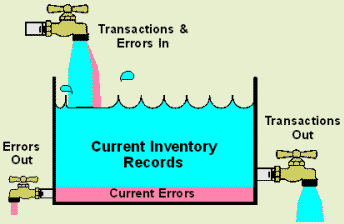
Figure 1 Inventory Error Rates
Methods For Improving Accuracy
To improve inventory record accuracy, the error creation rate (i.e. errors per week, month, etc.) must be less than the error removal rate. to increase accuracy we can decrease errors flowing in or increase the removal rate. Methods to improve accuracy include Cycle Counting, Physical Inventory, Transaction Reduction and Process Improvement. An optimal approach uses them all.
Physical Inventory-- In a physical inventory, normal operations cease while a physical count of every item is conducted. The counts are compared to inventory records and, when necessary, the records are corrected.
Cycle Counting-- A small number of items are physically counted, daily, on a random or semi-random basis. The physical count is compared to the inventory record. When necessary, the records are corrected.
Process Improvement-- Process Improvement examines the transaction processes. Changes are identified that reduce the probability of error.
Transaction Reduction-- The most effective way to reduce errors is to reduce the number of transactions. Fewer transactions introduce fewer errors. Kanban, BOM simplification, cellular manufacturing and other elements of Lean make this feasible. y

■ ■ ■ ■ ■ ■ ■

|
The Strategos Guide To Value Stream and Process Mapping goes beyond symbols and arrows. In over 163 pages it tells the reader how to do it and what to do with it. |

The free newsletter of Lean strategy