
Chaos In Scheduling
How To Stabilize The Scheduling System

Most scheduling systems are "feedback systems." Such systems can become unstable under certain conditions and produce erratic and unpredictable behaviors. Instability and fast response are often opposed in such systems. This creates significant problems for the designers and users.
Automatic Control and System Theory along with the new branch of Physics known as Chaos also contributes to our understanding. Chaos is quite common in scheduling and other business systems.
While these pages are conceptual and theoretical, a basic understanding helps to understand real scheduling systems and improve their performance.
Series Summary
Scheduling systems are feedback systems, i.e., a controller measures the current system state, compares it to a desired state and takes action to eliminate the difference.
Chaotic systems are similar to feedback systems in that the future state depends on the current state plus some action. They are governed by precise deterministic evolution equations, but have unpredictable and seemingly random behavior.
Such systems are subject to instability and chaos.
Ashby's Law implies that complex processes require complex scheduling systems. When processes are simplified (as in Cellular Manufacturing) the scheduling system can be simplified.
Since complexity is a root cause of chaos and instability, simple processes and simple control systems are highly beneficial.
To Minimize instability and chaos:
Keep It Simple
Implement Flow Lines & Cells
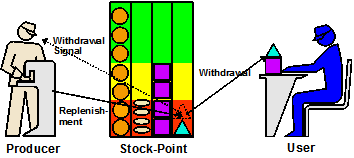
Employ Kanban, Direct Link & Broadcast
Reduce All Time Delays
Schedule Frequently
Increase Linearity
Minimize Unnecessary amplification

Jay Forrester was an expert on feedback control systems who designed fire control systems during World War II, In the early 1960's he investigated the application of system theory to a wide range of business and industrial systems. His book, "Industrial Dynamics," has become a classic. Peter Senge and others at the Massachusetts Institute of Technology extended this work in more recent times.

■ ■ ■ ■ ■ ■ ■
|
The Strategos Guide To Value Stream and Process Mapping goes beyond symbols and arrows. In over 163 pages it tells the reader how to do it and what to do with it. |

The free newsletter of Lean strategy