
Capacity, Inventory, Delivery & Variability
How High Capacity Utilization Degrades Delivery Performance
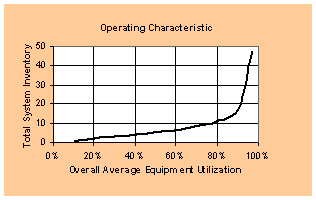
Inventory & Capacity Utilization
High capacity utilization increases inventory and degrades delivery performance. This principle holds true for most practical manufacturing situations. It has important implications for marketing, manufacturing, facility and financial strategies.
The figure shows how inventory typically increases with increasing utilization of factory equipment. At low utilization rates, inventory is present only at workstations and the job is worked quickly. As utilization increases, queues form and inventory builds. As average utilization approaches the practical maximum, inventory rises quickly, theoretically to infinity.
Little's Law
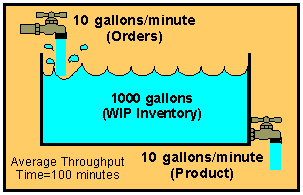
Little's Law states that average throughput time through a production system is directly proportional to average inventory. Think of a tank of water with a constant inflow and a constant, identical outflow:
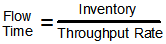
In this analogy, the input spigot represents orders coming to the factory. The outlet represents finished product. Water in the tank represents WIP inventory. Average throughput or dwell time in the tank is 100 minutes. If we lower the level to 100 gallons and maintain the same flow, throughput time is only 10 minutes.
Delivery Performance
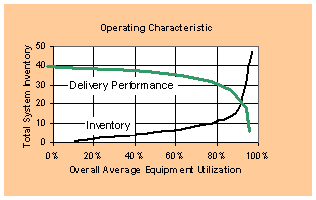
Delivery performance has at least two dimensions: speed and reliability. Speed is how fast you deliver; reliability is how dependable your delivery dates are. For a variety of reasons, speed and reliability are linked: fast deliveries are usually more reliable.
Little's Law is the connection between capacity utilization and delivery performance. As utilization increases, inventory increases, throughput time increases and delivery performance declines. The chart shows this effect qualitatively.
While a finished goods inventory can compensate for excessive lead time, it also creates a new set of problems.
Conditions For Application
- If there are multiple products and variability in routings or work times among those products, Little's Law holds for long-term averages but not, necessarily for individual pieces or orders.
- Units of measure must be consistent. For example, if inventory is measured in $$ and flow time is measured in days then the throughput rate is in $/day.
Variability-- The Root Cause
Variability causes this peculiar relationship between capacity and inventory. It is inherent in most work processes. Variation in work time, routing, quality and batching creates and exacerbates these effects. For more on this, see our upcoming page on Manufacturing Variability.
Implications for Strategy
The strategic implications in finance, marketing and manufacturing are important and profound. For more on these specific implications,click here.

■ ■ ■ ■ ■ ■ ■

|
The Strategos Guide To Value Stream and Process Mapping goes beyond symbols and arrows. In over 163 pages it tells the reader how to do it and what to do with it. |

The free newsletter of Lean strategy